The fields of Physics and Astronomy encompass the study of very small particles like neutrinos that can fly through us to the study of gravitational waves generated during the collision of massive black holes (the LIGO detector in Hanford, Washington, was one of the instruments used to detect these waves in 2015). Physics and Astronomy both depend on experimental measurements done by teams of scientists, often from countries around the world. The ability to design good experiments, take meticulous measurements, think critically and work together in teams is essential for a physicist.
By participating in any of the Physics CURE courses, students will develop the following transferable skills:
- Propose a scientific question and state a hypothesis
- Design an experiment to answer a question
- Practice precision experimentation through repetition
- Collect and analyze data
- Draw conclusions from data to support or refute a hypothesis
- Present your experiment and analysis to your classmates
- Learn to work in a team
Physics 114
Instructor: Simons
Dr. Simons has received funding from the STEM Transfer Partnerships program, a partnership between Green River College and University of Washington Engineering. The Clean Energy Institute (a partner in this program) has donated model solar cell cars to Green River College.
As a student in Dr. Simons class, you will be designing experiments, making measurements on the motion of these solar cars, and investigating how different types of energy can be transformed into each other. You will be supported by Dr. Simons at every stage of your project.
Instructor: Solomonson
In this section, you will be given scaffolded instructions to develop your own experiment. Dr. Solomonson will give you some suggestions for experiments related to the study of motion and energy. You may use one of these suggestions or modify it after discussing it with your team and the instructor. The project will be a set of scaffolded assignments. You will get constant feedback and support from the instructor every step of the way.
PHYS &221 (Solomonson)
PHYS &222 (Solomonson)
PHYS &223 (Solomonson)
This is the last course in the sequence. Topics covered are Circuits, Magnetism, Electromagnetism, Oscillations and Waves. Students now have sufficient experience to tackle a more complex project. They are given more independence with choice of topic (as long as it relates to the physical sciences or engineering). Students are encouraged to pursue a topic that is of interest to them and to finish a capstone project that they can showcase at the Green River College Student Showcase.
Examples of past projects:
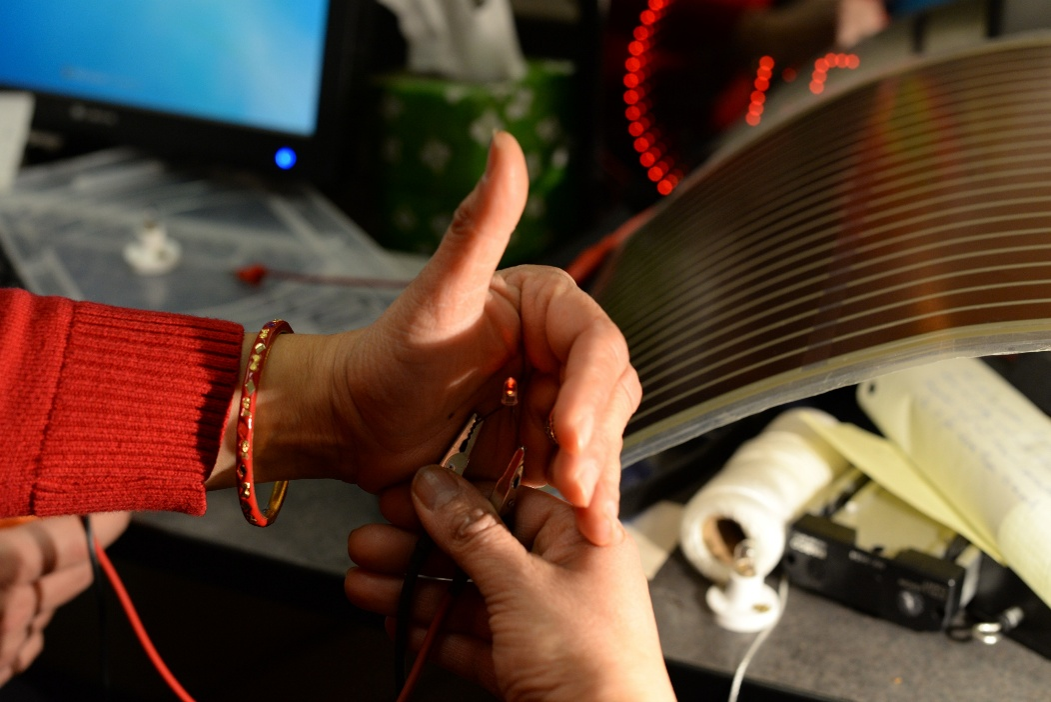
- Fabricating solar cells and optimizing them for maximum efficiency.
- Launching a hot air balloon and measuring atmospheric conditions (in conjunction with Pierce College and Central Washington University.
- Studying and demonstrating The Intermediate Axis Theorem.
- Learning to take images with an Atomic Force Microscope.
- Studying the rolling motion of objects with different moments of inertia.
- Projects using Arduino kits